
Table Of Contents
- Why Daily Puzzles Fit Busy Lives
- What Research Says
- How To Choose The Right Puzzle
- How To Build A Simple Routine
- Using Puzzles As Screen Breaks
- Keeping The Challenge
- Making Puzzles Social
- A Simple Seven-Day Plan
A daily puzzle habit does not need to take over your schedule to feel worthwhile. A short crossword, number grid, word search, or logic challenge can give your mind a clear task when the rest of the day feels crowded. Whether you enjoy paper books or digital games, you can visit this website to explore puzzle formats that suit a quick, repeatable routine.
The most sustainable approach is usually the simplest one: choose a puzzle you genuinely like, set aside a few minutes, and return to it often enough that it becomes familiar. The goal is not to maintain a flawless streak or solve everything quickly. It is to create a small moment of focused enjoyment that fits real life.
Why Daily Puzzles Fit Busy Lives
Short activities are easier to repeat than ambitious plans. Five to fifteen minutes can fit beside morning coffee, during a lunch break, on public transit, or in the quiet stretch before bed. For example, completing a few crossword clues before checking social media can turn an automatic scrolling habit into a deliberate mental reset. If a day gets away from you, begin again tomorrow.
What Research Says
Puzzles can support attention, recall, reasoning, and enjoyment, but they are not a cure for memory loss and should not be presented as a guaranteed way to prevent dementia. Different activities demand different skills, and getting better at Sudoku or crosswords mostly shows that you are learning those particular formats. Enjoyment still matters because a pleasant activity is far more likely to become a lasting habit.
Research on cognitive health supports a balanced view. The National Institute on Aging notes that cognitive training may benefit specific skills, while also cautioning that evidence does not show every commercial game has the same effect. Sleep, movement, meaningful learning, social connection, and appropriate medical care remain important parts of overall brain health.
One NIH-funded study followed adults for many years and found promising results from a specific speed-of-processing training program, rather than from all types of cognitive exercises. Its findings on cognitive speed training over weeks are encouraging, but they do not mean that any daily puzzle will produce identical long-term outcomes.
How To Choose The Right Puzzle
Match the puzzle to your mood, goals, and available time. A relaxed visual task may be better after a demanding workday, while a structured logic puzzle may feel satisfying when you want a sharper challenge.
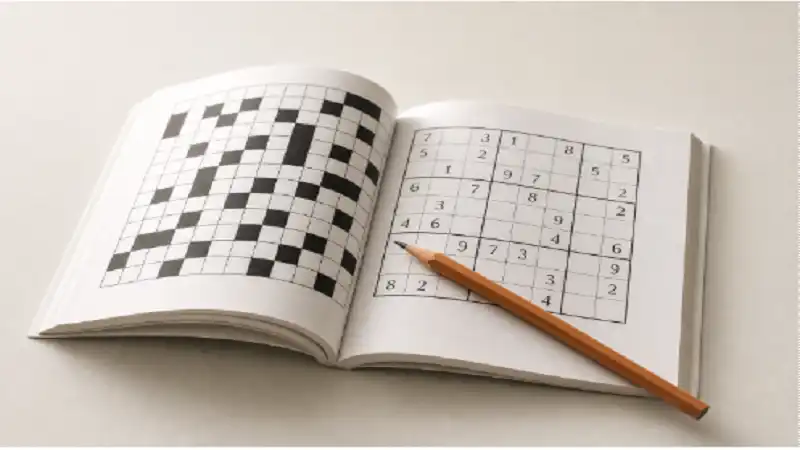
- Crosswords: Useful for vocabulary, general knowledge, and word recall. Start with short clues or familiar themes.
- Sudoku: Useful for logic and step-by-step reasoning. Choose beginner grids until the basic patterns feel natural.
- Word searches: Useful for visual scanning and calm concentration. Small grids make an easy five-minute break.
- Logic puzzles: Useful for deduction and organized thinking. Begin with fewer clues and a clear setup.
- Fill-ins: Useful for spelling and pattern recognition. A simple word bank offers a low-pressure entry point.
How To Build A Simple Routine
- Choose one cue. Attach puzzles to a regular moment, such as coffee, lunch, or winding down at night.
- Start small. Commit to five or ten minutes rather than a full book or difficult grid.
- Keep materials visible. Leave a pencil and puzzle book near your usual chair, or place an app on your home screen.
- Use a gentle goal. Aim to finish one small puzzle or piece of work before the timer ends.
- Track what helps. Note favorite formats, solving times, or completed sessions without turning the record into a source of pressure.
- Expect missed days. A missed session is normal, not a reason to abandon the routine.
Using Puzzles As Screen Breaks
Paper puzzles can feel especially restful after hours of emails, meetings, and notifications, but digital puzzles work well too when they are easy to access. Silence alerts for the session, use comfortable lighting, and sit in a position that does not strain your neck or hands. The point is to interrupt passive screen time, not to replace sleep, walking, meals, or time with other people.
Keeping The Challenge
Difficulty has a major effect on motivation. A puzzle that is always effortless becomes dull, while one that feels impossible can make a useful habit feel like another obligation.
A Helpful Difficulty Rule
- Choose mostly comfortable puzzles that let you experience regular progress.
- Add one slightly harder puzzle each week to practice patience and new strategies.
- Use hints as learning tools, not proof that you failed.
- Pause when your focus fades, then return later with fresh attention.
Making Puzzles Social
Puzzles do not have to be solitary. Solve clues with a partner, invite a child to find words in a grid, or compare different approaches with a friend. Family puzzle nights can be quiet and inexpensive, and collaborative solving shifts the focus away from scores toward conversation. For older adults in particular, shared activities can make a routine feel more connected and enjoyable.
Common Mistakes To Avoid
- Beginning with puzzles that are far beyond your current comfort level.
- Defining success only by speed or perfect completion.
- Assuming one puzzle type exercises every mental skill.
- Making health claims that go beyond the research.
- Ignoring eye strain, hand discomfort, poor lighting, or fatigue.
- Turning a relaxing hobby into a rigid daily test.
A Simple Seven-Day Plan
- Day One: Spend five minutes on an easy word puzzle.
- Day Two: Try a beginner Sudoku or short logic puzzle.
- Day Three: Use a word search as a screen break.
- Day Four: Return to a puzzle that felt slightly difficult.
- Day Five: Solve one puzzle with another person.
- Day Six: Experiment with a new puzzle type.
- Day Seven: Identify the format you enjoyed most and repeat it next week.